A working referenceReal Estate
Real Estate
Field Guide.
A plain-English guide to buying and selling residential real estate in the United States.
If you’re trying to figure out what’s actually happening at each step of buying or selling a home (what to ask, what to compare, what’s different by state), this is the reference for that. Articles describe how things work in general, calculators show the math, and every page cites where the rules come from.
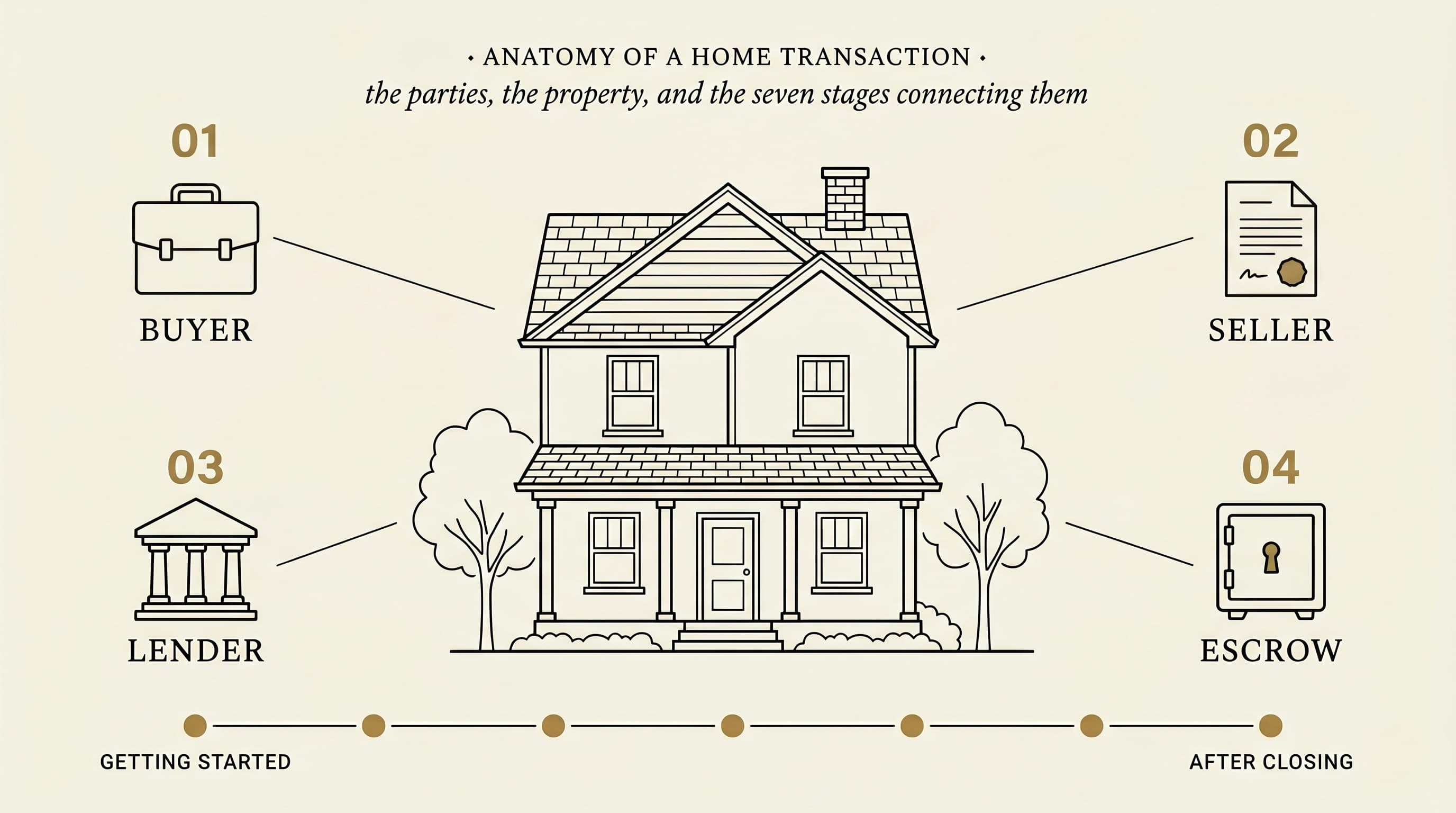
Four parties, one property, seven stages. The whole site, in one picture: how the pieces fit together and where each article lives in the larger system.
Pick a path
- Buying a homeThe buyer journey from deciding whether to buy through the first year of ownership.Buyer journey · seven stages
- Selling a homeThe seller journey from the question of whether to sell through the tax implications of the year you do.Seller journey · seven stages
- Just learningBrowse every article, glossary entry, and explainer without committing to a path.Article archive · A–Z
Start here
- How much house you can afford, and why the lender's number isn't the answerA lender's preapproval tells you the most you can borrow on paper. What you can comfortably afford to live with is usually a smaller number, and the gap between the two is where most first-time buyer regret starts.
- Rent vs. buy, the honest comparisonMost rent-vs-buy framing quietly favors buying, by understating ownership costs and assuming the rent-side savings just disappear. The honest version models full ownership cost, the investment alternative on the down payment, and shows the breakeven year explicitly.
- How a mortgage works, in plain termsA mortgage is two contracts, one piece of property, and a long string of mostly-interest payments. Knowing how the pieces fit together makes the rest of the homebuying process much less mystifying.
- Conventional, FHA, and VA loans, and what each one actually costsThe three main residential mortgage products work very differently underneath. Knowing which costs scale with the loan, which scale with the home, and which roll into the financed balance matters more than the rate quoted on the rate sheet.
- Capital gains on a home sale, the § 121 exclusion and what it actually coversThe IRS lets single filers exclude up to $250,000 of gain on the sale of a primary residence, $500,000 for married joint filers. Above the exclusion, the gain is taxable. The mechanics determine whether a sale produces a six-figure tax bill or no tax at all.
By location
Real estate rules vary meaningfully by state and city. Transfer taxes, attorney requirements, disclosure regimes, property tax mechanics, and closing customs are all jurisdiction-specific.
Featured states
- CaliforniaProp 13 caps reassessment; coastal premium markets dominate volume.
- New YorkMansion-tax cliffs at $1M and $2M; co-op vs. condo dichotomy.
- TexasNo state income tax, no transfer tax, attorney optional.
- FloridaPost-Surfside SIRS regime, Save Our Homes cap, no state income tax.
City guides
- AtlantaA plain-English overview of residential real estate in Atlanta, Georgia's attorney-required closing practice, the deed transfer tax plus intangibles tax structure, the metro's sprawling sub-markets, and the homestead exemption stack that varies meaningfully by county.
- ChicagoA plain-English overview of residential real estate in Chicago, the layered transfer-tax stack (state + county + city, split between buyer and seller), Cook County's triennial assessment dynamics, the high-rise condo market, and an attorney-customary closing practice.
- Los AngelesA plain-English overview of residential real estate in Los Angeles, Measure ULA's mansion tax above $5M, the spread of micro-markets across a sprawling metro, escrow-driven closings, and the Mello-Roos and supplemental property-tax dynamics specific to newer developments.
- MiamiA plain-English overview of residential real estate in Miami, the post-Surfside condominium safety reforms (SB 4-D), the international-buyer dynamics that distinguish Miami from most US metros, hurricane-and-flood insurance pressures, and the documentary stamp tax burden.
- New York CityA plain-English overview of residential real estate in NYC, the co-op vs condo distinction, the Real Property Transfer Tax (RPTT), the mansion-tax cliffs at $1M+, and a market that's structurally different from the rest of the country.
- San FranciscoA plain-English overview of residential real estate in San Francisco, TIC vs condo vs SFR scarcity, rent-control implications for sellers, the city's progressive transfer-tax brackets at higher prices, and the tech-cycle volatility that characterizes the local market.