Learning · General
What escrow actually means, and why people use the word three different ways
The word "escrow" can refer to the period before closing, the account that holds the buyer's earnest money, or the lender's account that pays property tax and insurance. They're related but not the same.
Key takeaways
- Escrow describes three different things in a real estate transaction, namely the escrow period (between contract and closing), the escrow account (held by the closing professional or lender), and lender escrow (monthly collection for taxes and insurance).
- During the escrow period, a neutral third party (escrow company, attorney, or title company depending on jurisdiction) holds funds and documents until contract conditions are satisfied.
- Lender escrow accounts collect 1/12 of annual property tax and homeowners insurance with each monthly mortgage payment, then pay those bills on the borrower's behalf, required on FHA and most low-down-payment conventional loans.
- The escrow holder is contractually neutral, not the buyer's agent, not the seller's agent, not the lender's representative.
Quick answers
- What does escrow mean in real estate?
- Escrow
- What is the escrow period?
- The escrow period is the time between contract signing and closing, when a neutral third party (usually a title or escrow company) holds the buyer's deposit and coordinates inspections, appraisals, lien searches, and document signatures. On the West Coast, the period is called "in escrow"; in the eastern US, the same period is more often called "under contract" with the work split among an attorney, a title company, and the lender. The labels differ; the work is similar.
- What is an earnest money escrow account?
- The earnest money escrow account is held by a neutral party (a title company, attorney's trust account, or broker's trust account, depending on state) and holds the buyer's deposit (typically a few percent of the purchase price) from contract signing through closing. At closing, the earnest money is applied to the down payment or closing costs. If the deal falls through, the contract's contingencies determine whether the deposit returns to the buyer or goes to the seller.
In residential real estate, "escrow" refers to three distinct things: (1) the period between contract signing and closing, when a neutral third party coordinates inspections, appraisals, and document signatures; (2) the account that holds the buyer's earnest money during that period; and (3) the lender's account that pays property tax and insurance after closing. The three meanings overlap, which is why the word confuses almost everyone the first time they encounter it.
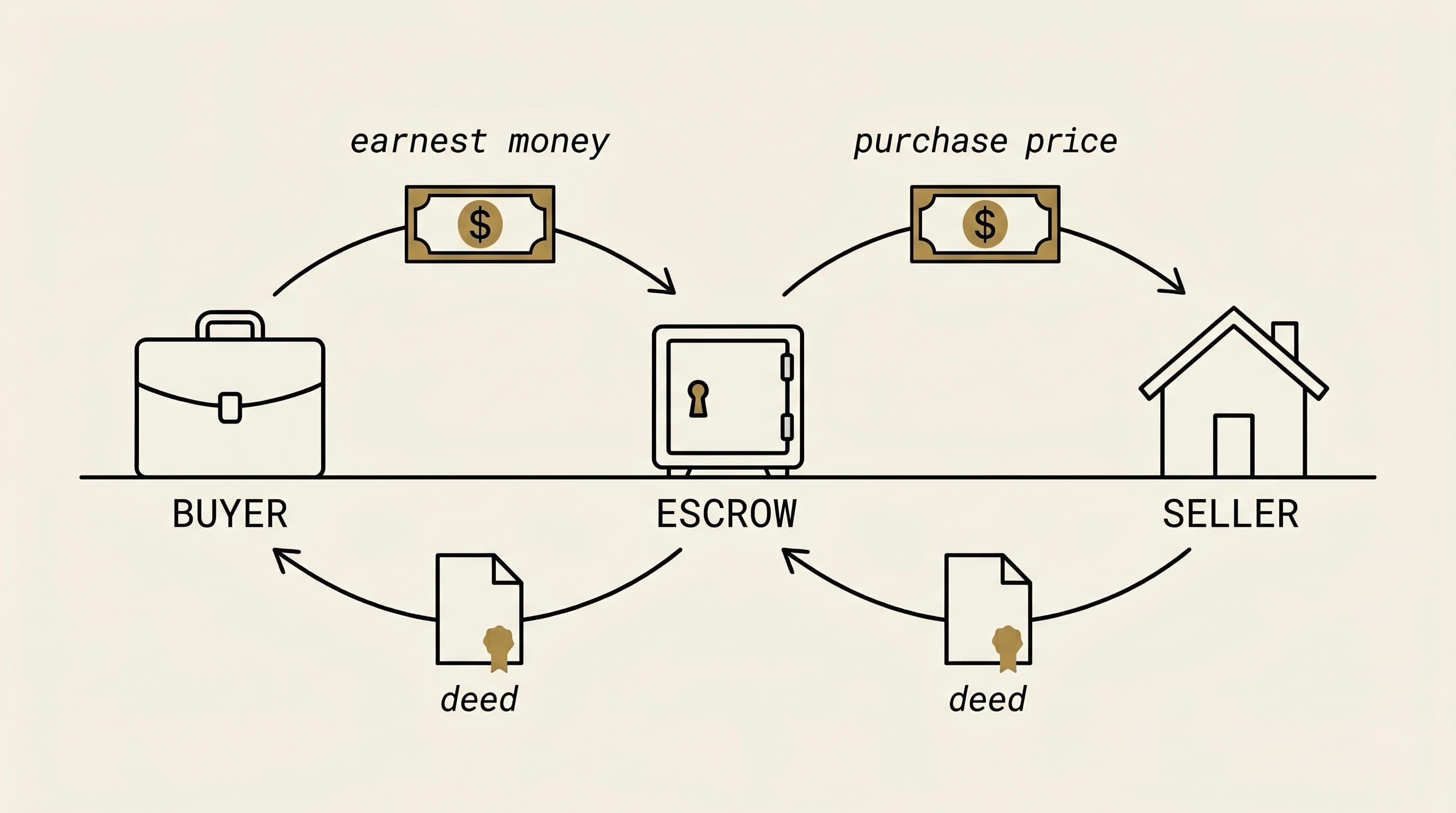
Escrow is the impartial middle. Money goes one way through it, the deed goes the other way through it, and neither leg releases until both legs are ready.
Real Estate Field Guide illustration
1. The escrow period (the time between contract and closing)
In some parts of the country, especially the West Coast, "in escrow" means the period after a purchase contract has been signed but before the deed has been transferred. During this period, a neutral third party (usually a title or escrow company) holds the buyer's deposit and coordinates the inspections, appraisals, lien searches, and document signatures the deal requires.1 The "escrow officer" works for that company.
In the eastern half of the country, the same period is more often called "under contract," and the role of the escrow officer is split among an attorney, a title company, and the lender. The work is similar; the labels differ.
2. The earnest money escrow account
When a buyer signs a purchase contract, they typically deposit earnest money (a few percent of the purchase price) into an escrow account held by a neutral party. Depending on the state, that party is the title company, an attorney's trust account, or the broker's trust account.2 The deposit signals that the buyer is serious and gives the seller something to keep if the buyer walks away outside the contract's contingencies.
The earnest money sits in escrow until closing, at which point it's typically applied to the down payment or closing costs. If the deal falls through, what happens to the earnest money depends entirely on the contract: contingencies preserved and walked away cleanly, deposit returns; contingencies expired or buyer breached, deposit may go to the seller. Disputes about earnest money are unfortunately common, which is why having an attorney review the contract before signing matters.
3. The lender's escrow (impound) account
Once a mortgage closes, most lenders require borrowers to make their property tax and homeowners insurance payments through a lender escrow account, sometimes called an impound account.3 Each month, alongside the principal-and-interest payment, the borrower pays roughly 1/12 of the annual property tax bill and 1/12 of the annual insurance premium into the escrow account. When the tax or insurance bill comes due, the lender pays it directly out of that account.
The mechanism exists for the lender's benefit, not the borrower's: a tax lien from unpaid property taxes can outrank the lender's mortgage lien, and a lapsed insurance policy leaves the lender's collateral uninsured. By controlling the payments, the lender controls the risk.
For the borrower, the practical effect is that the monthly payment is bigger than the principal-and-interest figure on the rate sheet, sometimes by 30 to 50 percent. A "$2,200 monthly payment" advertised as P&I can become $2,800 once taxes and insurance are folded in.
How the three meanings connect
The three uses share one thing: a neutral party holding money that doesn't yet belong to either side of the transaction. In the escrow period, the neutral party is coordinating the deal. In the earnest money case, they're holding the buyer's deposit while contingencies clear. In the lender escrow case, they're holding the borrower's tax-and-insurance reserves between billing cycles.
The single most useful thing a buyer can do when someone says "escrow" is ask which one they mean. The answer often clarifies an otherwise confusing conversation about who is holding what money and what triggers its release.
Common gotchas
A few things that catch first-time buyers off-guard. Escrow accounts get analyzed annually and can come up short if property tax or insurance went up, the lender adjusts the monthly payment to catch up, sometimes substantially. Earnest money disputes can take weeks or months to resolve when both sides claim entitlement, and the escrow holder typically won't release the funds without a written agreement or a court order. The third is the optional-vs-required lender escrow distinction: some loans (especially with under 20% down or in higher-cost states) require lender escrow, others don't. Borrowers who waive lender escrow are responsible for paying tax and insurance bills on their own, and for documenting it when the lender asks.
Frequently asked
What does escrow mean in real estate?
EscrowWhat is the escrow period?
The escrow period is the time between contract signing and closing, when a neutral third party (usually a title or escrow company) holds the buyer's deposit and coordinates inspections, appraisals, lien searches, and document signatures. On the West Coast, the period is called "in escrow"; in the eastern US, the same period is more often called "under contract" with the work split among an attorney, a title company, and the lender. The labels differ; the work is similar.What is an earnest money escrow account?
The earnest money escrow account is held by a neutral party (a title company, attorney's trust account, or broker's trust account, depending on state) and holds the buyer's deposit (typically a few percent of the purchase price) from contract signing through closing. At closing, the earnest money is applied to the down payment or closing costs. If the deal falls through, the contract's contingencies determine whether the deposit returns to the buyer or goes to the seller.What is the lender's escrow account?
The lender's escrow account (also called an impound account) holds 1/12 of the annual property tax bill and 1/12 of the annual insurance premium each month, alongside the principal-and-interest payment. When the tax or insurance bill comes due, the lender pays it directly. This mechanism exists for the lender's protection, a tax lien outranks the lender's mortgage, and a lapsed insurance policy leaves collateral uninsured. The practical effect for the borrower is a monthly payment 30-50% larger than the P&I figure on the rate sheet.What are common escrow gotchas?
Three common ones. (1) Lender escrow accounts get analyzed annually and can come up short if tax or insurance rates rose, triggering an adjusted monthly payment to catch up. (2) Earnest money disputes can take weeks or months to resolve when both sides claim entitlement, the escrow holder typically won't release without a written agreement or court order. (3) Some loans require lender escrow (typically under 20% down or in high-cost states); others don't, and borrowers who waive it must pay tax and insurance bills directly and document it when the lender asks.