Buying · Under Contract
What loan underwriting actually checks, between contract and closing
Underwriting is the lender's verification process, confirming the buyer's income, debts, credit, assets, and the property itself before funding the loan. Most underwriting issues show up in the under-contract period, and most of them are resolvable if caught early.
Key takeaways
- Lenders evaluate four things, often called the four Cs, namely credit (payment history and FICO), capacity (income and DTI), collateral (the appraised property value), and cash (down payment plus reserves).
- Preapproval is a preliminary review based on borrower-stated information; full underwriting verifies each bucket against tax returns, pay stubs, bank statements, and the appraisal report.
- The conventional FICO floor is 620; FHA accepts 580 with 3.5% down or 500 with 10% down; VA has no formal minimum but most VA lenders require 580–620.
- Lenders re-pull credit and re-verify employment shortly before closing, so large credit-card balances or job changes during the escrow window can derail a previously-approved loan.
Quick answers
- What does a mortgage underwriter check?
- An underwriter verifies four buckets, often called the four Cs, credit (payment history and score), capacity (income relative to debt), collateral (the appraised property and clear title), and cash (down payment plus reserves). The window typically runs 30-45 days between contract acceptance and closing, with documentation requests flowing back and forth until the lender issues "clear to close."
- What are the four Cs of underwriting?
- Credit is verified through a fresh credit pull confirming score and recent payment history. Capacity is verified through W-2s, pay stubs, two years of tax returns for self-employed borrowers, and direct employment verification. Collateral is verified through the appraisal and title search. Cash is verified through two months of bank statements across all accounts, with every large deposit sourced via paper trail. Gift funds are allowed under most programs but require a formal gift letter.
- What can derail a loan during underwriting?
- The most common causes are borrower actions during the under-contract window that change the qualification picture, opening new credit (cards, store credit, car loans), job changes (especially career changes or commission-based roles), large unsourced deposits, late payments on existing debts, and address-history or identity-verification discrepancies. The conventional posture during underwriting is no major credit or financial moves until after closing.
Loan underwriting is the lender's formal verification process between contract acceptance and closing, confirming the borrower's credit, income, debts, assets, and the property itself before the loan is funded.1 The window typically runs 30-45 days, parallel with the inspection and contingency periods, and most issues that surface here are resolvable if caught early.
Preapproval is preliminary, a high-level review of credit, income, and assets that lets the buyer make offers with credibility. Full underwriting is the lender actually verifying everything against documentation, ordering the appraisal, examining the property, and making a final yes-or-no decision.
Most deals close on schedule. The ones that don't usually trace back to something underwriting surfaced that wasn't caught in preapproval, or that changed during the under-contract window in ways that affected qualification.
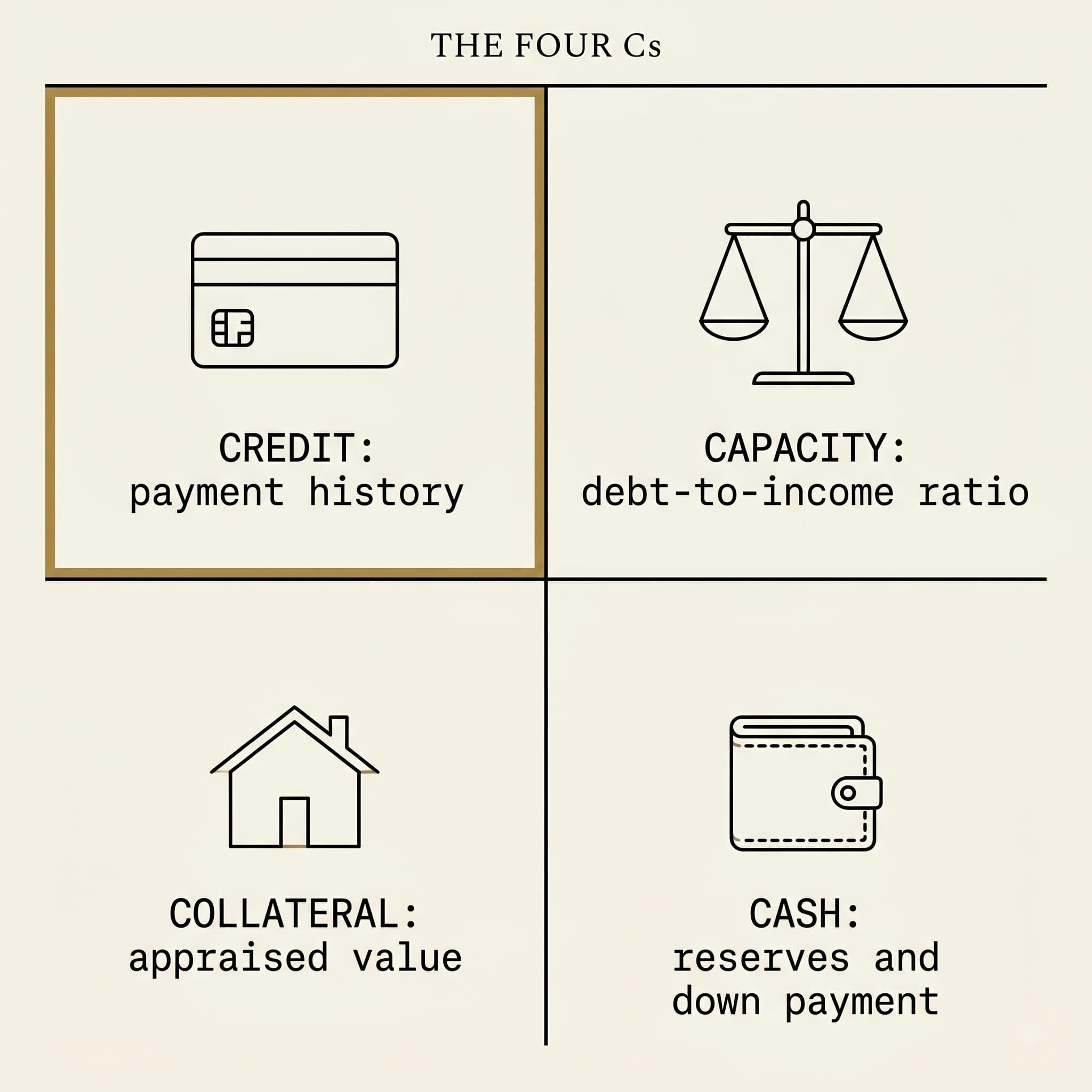
Underwriting comes down to four questions. The brass border around CREDIT marks it as the binding constraint for most first-time borrowers: the one that determines whether the rest of the conversation happens at all.
Real Estate Field Guide illustration
The four buckets, again
Underwriting reviews the same four buckets that informed preapproval (credit, capacity, collateral, cash) but with documentation depth that wasn't required earlier.2
Credit is verified through a fresh credit pull (different from the soft pull at preapproval). The lender confirms the credit score, the recent payment history on existing debts, and any new accounts or balances. Lenders sometimes do a "soft pull" again right before closing to confirm nothing has changed; new debt opened during the under-contract period can disqualify the loan.
Capacity (income relative to debt) is verified through W-2s, recent pay stubs, two years of tax returns for self-employed borrowers, employment verification (often a phone call to HR), and direct verification of any rental income, alimony, or other reported sources. Underwriters scrutinize income consistency. Big swings or recent job changes need explanation, sometimes with letters from employers or CPAs.
Collateral is verified through the appraisal and the title search. The appraisal confirms the property is worth what the loan is being made against; the title search confirms the seller can deliver clear title. Either can produce surprises, a low appraisal triggers the appraisal-contingency conversation; an unexpected lien or title defect requires resolution before closing.
Cash (down payment plus reserves) is verified through bank statements, often the most recent two months across all accounts. Underwriters look for the source of every large deposit; unsourced deposits (money that suddenly appeared without a clear paper trail) typically can't be used as down payment unless explained and documented. Gift funds from family are allowed under most programs but require a formal gift letter and source documentation.
What changes during underwriting that can derail the loan
The most common cause of late-stage underwriting issues is something the borrower did during the under-contract period that they didn't realize would matter. The list of things that can cause problems:
Opening new credit. A new credit card, a furniture purchase on store credit, or a new car loan can shift the back-end ratio enough to disqualify the loan. The conventional posture during under-contract is to make no major credit changes.
Job changes. A new job, especially in a different industry or with a different compensation structure, requires re-verification. The lender has to confirm the new income is stable and qualifying. Some job changes (same company, same role, modest raise) are fine; others (career change, contract role, commission-based) trigger a full re-evaluation.
Large unsourced deposits. A $10,000 deposit into the borrower's account during the under-contract period that can't be sourced (gift, sale of assets, tax refund, etc.) creates a problem. Underwriters need a paper trail.
Late payments. Missing a payment on an existing debt during underwriting can drop the credit score enough to affect qualification or pricing. Late payments are usually explainable but require documentation.
Address discrepancies and identity issues. Inconsistencies between the borrower's stated address history and what credit bureaus show, or any flag in the identity-verification process, can hold up the loan.
Conditional approval and clear-to-close
Underwriting typically produces a "conditional approval", the loan will be approved if specific conditions are met. The conditions are often documentation: an updated bank statement, a CPA letter, a written explanation of a credit-report item. The borrower's job during this period is to respond quickly to documentation requests, because underwriting clocks tick toward closing.
When all conditions are satisfied, the lender issues "clear to close", the final approval that allows closing to be scheduled. The Closing Disclosure is sent at least three business days before closing per federal rule, and once the three-day period has run, closing happens.
What happens if underwriting denies the loan
Outright denials are uncommon at this stage, most issues are caught at preapproval, and remaining risks usually surface as conditional-approval requirements rather than full denials. But denials happen, typically for one of three reasons: a material change in the borrower's financial picture (job loss, large debt added, credit score drop), a property issue (low appraisal, title defect, condominium project not approved by the lender), or a documentation issue that can't be resolved (income that can't be verified, gift funds that can't be sourced).
If the financing contingency is in place, a denied loan usually allows the buyer to terminate the contract and recover the earnest money. The contract language is what governs, and the timing matters. The financing contingency typically has a specific window after which it expires, and termination after that window can put the deposit at risk.
A useful frame
Underwriting is mostly a documentation exercise. The deals that close cleanly are usually the ones where the borrower made few financial moves during the under-contract period and responded promptly to lender requests. The deals that go sideways are usually ones where something changed (new debt, a job change, an unsourced deposit) and the change wasn't communicated to the loan officer in time. The single most useful thing a borrower can do during the under-contract window is treat their financial life as frozen: no new credit, no job changes, no major deposits without documentation. The clarity that produces makes the underwriter's job (and the borrower's life) significantly easier.
Frequently asked
What does a mortgage underwriter check?
An underwriter verifies four buckets, often called the four Cs, credit (payment history and score), capacity (income relative to debt), collateral (the appraised property and clear title), and cash (down payment plus reserves). The window typically runs 30-45 days between contract acceptance and closing, with documentation requests flowing back and forth until the lender issues "clear to close."What are the four Cs of underwriting?
Credit is verified through a fresh credit pull confirming score and recent payment history. Capacity is verified through W-2s, pay stubs, two years of tax returns for self-employed borrowers, and direct employment verification. Collateral is verified through the appraisal and title search. Cash is verified through two months of bank statements across all accounts, with every large deposit sourced via paper trail. Gift funds are allowed under most programs but require a formal gift letter.What can derail a loan during underwriting?
The most common causes are borrower actions during the under-contract window that change the qualification picture, opening new credit (cards, store credit, car loans), job changes (especially career changes or commission-based roles), large unsourced deposits, late payments on existing debts, and address-history or identity-verification discrepancies. The conventional posture during underwriting is no major credit or financial moves until after closing.What is conditional approval versus clear-to-close?
Conditional approval means the loan will be approved if specific conditions are met, typically documentation requests like an updated bank statement, a CPA letter, or a written explanation of a credit-report item. Clear-to-close is the final approval after all conditions are satisfied, allowing the closing date to be scheduled. Federal rule requires the Closing Disclosure to be sent at least three business days before closing.What happens if underwriting denies the loan?
A denial typically traces to one of four causes, insufficient income relative to debt, credit score below the program threshold, an appraisal that came in too low, or unresolvable issues with the property's title. The buyer's options depend on the contract's financing contingency, an active contingency lets the buyer terminate and recover earnest money. Sometimes a denial is reversible by switching loan products (FHA instead of conventional, for instance) or by another lender with different overlays.